
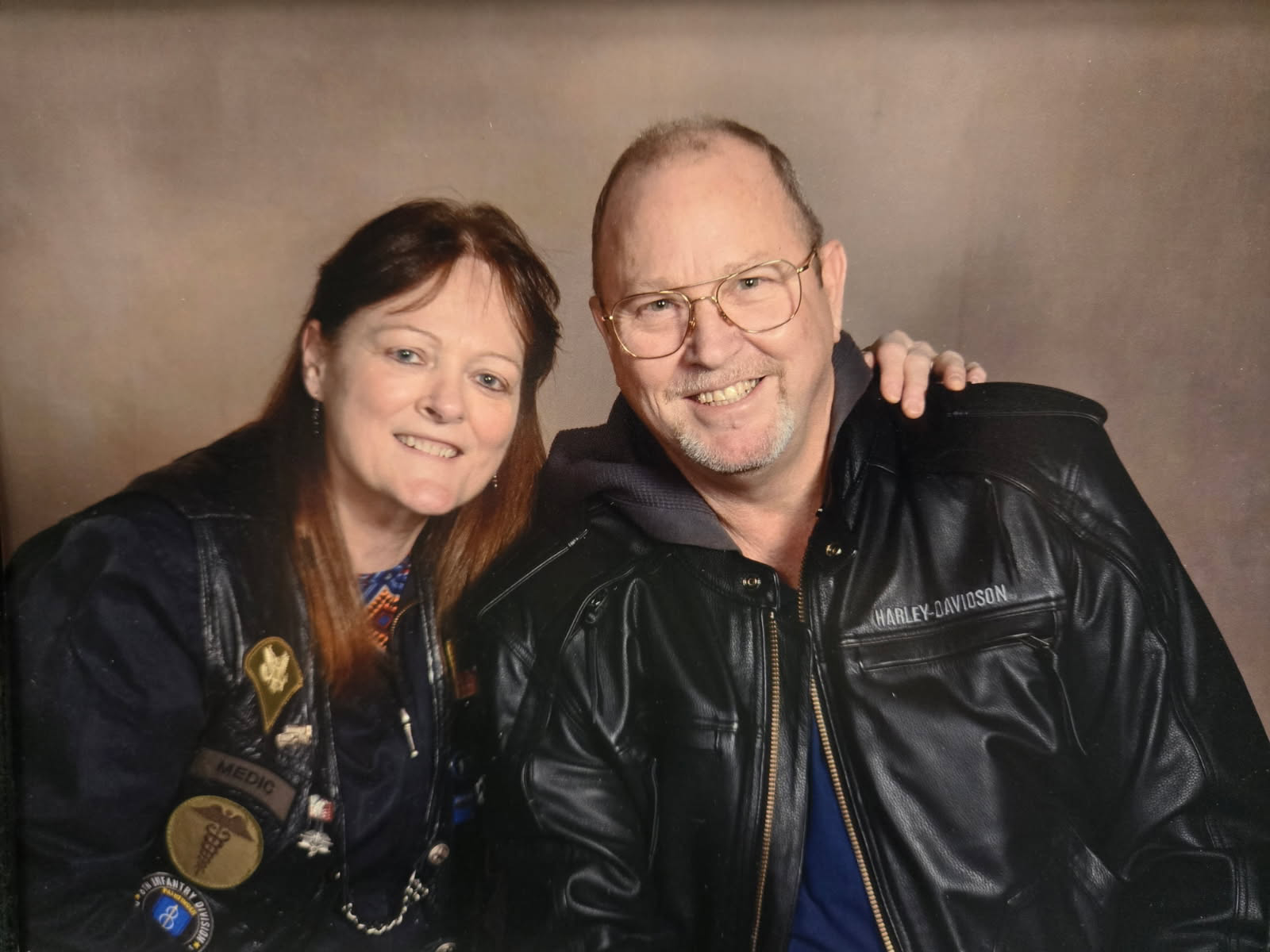
Some people spend retirement resting. Russ and Tamara Goodman spent it loading a fifth wheel and driving into disasters.
He is an Army veteran and diesel mechanic who spent 27 years in trucking and a final stretch at the IRS. She is a licensed mental-health clinician and Army combat medic who built a 44-year career out of her own brokenness. Together they are Foursquare Disaster Relief responders — national trainers, a chaplain-and-grunt team, and, in their own words, a 'yes people.'
In this conversation, they trace two very different roads to the same storm: a prodigal who returned after fifty years, and a woman rescued at twenty-two from the wreckage of her own life — both now called to carry hope into the wreckage of other people's.
Two Different Roads
Russ grew up a military brat. From the day he was born he never lived any one place too long — moving nearly every year, coast to coast, changing schools constantly and falling behind in more than one subject along the way.
It was a life that let him see places most people only vacation — at one point he lived right across the creek from Mount Vernon, George Washington's home — but the constant moving came with its own trials. In his adult years he bounced between jobs before settling into the trucking industry for 27 years, with a seven-year split in the middle to serve in the Army as a diesel mechanic. He loved the work — three of those years he spent training others to rebuild engines — though it took a toll on his body. He eventually moved on to the IRS, and retired from there.
Tamara's road was harder. She grew up in a deeply dysfunctional home marked by domestic violence and trauma — her mother married four times, her father gone for years — and she made more than her share of high-risk choices trying to find her way through it.
A Sliver of Hope
In 1982, Tamara landed in detox at Washington House in Fort Wayne — about 110 pounds, jaundiced, and, in her own words, not really wanting to live anymore.
An old counselor of hers got word and came to see her. She sat for hours and listened. And through that woman's quiet faith, Tamara caught what she needed most:
"Just a sliver of hope that maybe, just maybe, things could turn around."
She went from detox into long-term treatment at Brandon House in Kankakee, Illinois — a move she made on one last prayer: if God was real, this was it. A church outreach from Spirit of God Fellowship in South Holland, Illinois, came to the facility, and Tamara, who admits she first came for the food, found herself, over a few months, turning her life over to Christ. She accepted Jesus around April of 1982, at twenty-two years old.
She felt the Holy Spirit tell her something in treatment that she never forgot:
"It takes a lot more courage to stay than it does to walk out that door."
She stayed. And it set the course of a life. She became a credentialed mental-health professional and built a 44-year career helping people out of situations like her own — with a four-year break from 1988 to 1992 to serve her country as an Army combat medic. When she got out, she told God she was done working on bodies; she wanted to work on the mind, the will, and the emotions. She retired from the Department of Veterans Affairs three years ago. She still keeps her license.
Fifty Years as a Prodigal
Russ's story of finding God actually began about fifty years before he did. When he was six and a half, his father — a pilot — was shot down over North Vietnam and killed. His last memory of his dad was a flag-draped coffin in a military chapel.
At six, he blamed the church for killing his father. Raised Episcopalian, he refused to go back — and because a six-year-old couldn't be left home alone, his family stopped going too.
By his sophomore year, he knew that thinking had been wrong, and he began to search. He told his story to the head father at the Catholic high school he attended in Pensacola, Florida, and was condemned for it. Months later, Marine Corps friends who were Episcopalian invited him to their church. He sat down with the pastor afterward. 'Not good,' he says — condemned again. He swore he was done with God, and walked away from everything.
For fifty years he lived as what he calls a proverbial prodigal — yet all the while he held a stubborn belief in guardian angels, certain his father was his. He had survived more than one situation he shouldn't have, and he credited that quiet protection.
Even in college, the search had a cost. A born-again chemistry lab partner in San Diego shoved God at him daily until Russ finally sat him down on a bench outside the lab and made him a deal: stop trying to shove God down my throat, or your body will disappear into a canyon somewhere. The man got the point. And that became Russ's expectation of any church that might come knocking — if it ever did.
A Church That Only Showed Love
He met Tamara in 2015. Before they ever dated, they rode motorcycles together and talked about a church in Fort Wayne — Life Bridge Church. Russ warned her plainly: if he ever walked in and somebody shoved God down his throat, he would be out before the sermon started. She just smiled.
On January 19, 2016 — a date he can still recite years later — he woke up one Sunday morning with something telling him to go check it out. He showered, drove over, and walked in fully expecting the condemnation he'd been handed everywhere else.
Instead, he got nothing but love and friendship. Tamara introduced him around until he joked he hoped there wasn't a quiz on the names. He kept coming back.
After twelve years of counseling at the VA, he decided to step away and began meeting with the pastor, Bill Campbell. Pastor Bill gave him a video series — teachings on the orphan spirit, on woundedness and brokenness and childhood, drawn from the work of Jack Frost — and Russ was stunned to find that probably half of it could have been written about his own life.
He accepted Christ quietly, in conversation with the pastor — so quietly, in fact, that Tamara didn't even know until he wanted to be baptized that March. She had been telling everyone her news; he had been subtle about his. He went under the water, and the rest is history. Pastor Bill Campbell, he says, became a father figure to him — their 'wise guy' — and Life Bridge Church the first place that ever showed him only love.
The Word in the Night
The calling came the way God most often speaks to Russ — not in the open, but in his sleep.
In the summer of 2022, he was retiring from the IRS on September 30; Tamara had already retired from the VA at the start of the year. He had no idea what he wanted to do. Then he began hearing two words at night:
Disaster relief.
About two weeks before he retired, they went to Israel. And there, the words started coming by day as well as by night. He ignored them. Five days after they got home, he retired.
A couple of weeks later, Emily Crosser — the former director of Foursquare Disaster Relief — was speaking at Life Bridge. Sitting there, Russ says it felt like God slapped him upside the head: are you ready to listen yet? On his way out of church, he walked up to the pastor and said he finally knew what he was supposed to do in retirement.
Tamara felt the same pull. With her background as a licensed clinician and his as a veteran and mechanic, it fit — a joint venture. She frames retirement differently, and it stuck: not retirement, but refirement. And these two Army veterans — his service as a diesel mechanic, hers as a combat medic — were perfectly formed for it.
On the Ground
Disaster relief, in their hands, looks like this: when a storm hits, Foursquare sends a small advance team to work with the local pastors — because once a team is on scene, they work for those pastors. Sometimes the need is mostly chaplains. Sometimes it's what Russ calls grunts — hard physical labor — and that's where the two of them make a team. She is the chaplain. He is the grunt.
There is drywall to cut out, mud to shovel, mold to kill, ceramic flooring to pull up, roofs to patch, debris to clear. And, always, people to pray with. Russ has deployed to Oklahoma, North Carolina, Florida, and Hawaii; Tamara to North Carolina and Florida — Hawaii she missed only because she was too sick to fly.
Every responder is trained to FEMA standards, so that on scene everyone understands the chain of command and can work as one. Deployments run a week at a time. Go-bags are always packed. Sometimes the call comes at noon, and by four o'clock Russ is hooked to his camper heading for the storm. When they were driving home from North Carolina, they got the email to turn around for Florida — packed back up, rolled by Wednesday. They upgraded to a fifth wheel that can sleep at least five, so they carry a whole team with them.
And on the ground, one of Foursquare's mantras has become theirs:
"You can't be flexible — you must be fluid."
Flexible is too rigid for what actually happens. In North Carolina, with Hurricane Milton bearing down on Florida, a team had to be pulled out for safety and sent to Atlanta. The week changed in a moment. You learn to flow.
Miracles in the Wreckage
In Sulphur, Oklahoma — headquarters of the Choctaw Nation, the most Christian Indian nation in America — a tornado cut straight through downtown. Not one Choctaw building was touched; their maintenance yard, their trucks, all of it, untouched, while nearly everything around them was flattened.
A couple in their late twenties or early thirties — Mike and Shelly — were living on the second floor of an apartment building just across the street from the Choctaw maintenance yard. The roof didn't tear off; it collapsed into their apartment. They ran for the casino parking garage, staring at the tornado the whole way. At the last road, Shelley's feet lifted off the ground — the storm was pulling her in. Mike, a big man, held on and yanked her down, and they made it inside.
The day after the tornado, they got saved. When they went back to recover what they could, they found both cell phones and her wallet — but not Mike's. He'd only kept an ID in it, so he wasn't too bothered. Then a casino employee tracked him down at the shelter: a woman had found the wallet a half to three-quarters of a mile away, lying in the middle of an intersection. When Mike opened it, it was fat with cash — enough to buy a car and pay for a year of insurance. Somehow the woman and her husband had figured out these people were indigent and quietly left it full of hundreds.
A few days later, Mike came running out to tell them his prayer story. He'd prayed for a simple cheeseburger — the mercy meals at the shelter were a little too fancy for meat-and-potatoes people — and inside thirty minutes a man pulled up in a pickup with a whole bed full of fresh hot cheeseburgers. Mike held up three fingers with the biggest grin: he'd eaten three of them.
And in Florida, after Helene and Milton, there was a grandmother raising a grandson, maybe five or six years old. His belly was swollen and distended, his color off, his joy gone — nothing like a kindergartener should be. They prayed for him and for her. Within days of getting home, the grandmother reached the team leader, sending photos: the boy was completely healed. His belly was normal, his color returned, his pain gone. A doctor's visit confirmed it — they could find nothing wrong. He was playing, smiling, himself again.
These, they say, are the blessings that keep them on mission. God takes what the enemy meant for destruction and turns it into provision, healing, and life.
Come and Get Trained
If there is one thing Russ and Tamara want every listener to hear, it is this: get trained. You can do it online or in person; you can find a course at Foursquare Disaster Relief's events page. The training is free, beyond your time. And you don't have to deploy to be worth something.
Here is the reality they have seen — in Hawaii especially — when people show up to help without being certified responders: they get in the way. In one flooded agricultural valley, the police had to seal off the area completely. Anyone not a certified responder was turned away. Untrained good intentions, they are blunt about, can cost a life — the life of the person trying to help, or the lives they came to save.
Foursquare is now prepositioning stocked disaster-relief trailers around the country — in San Antonio, in Ohio, the next likely Denver — so a trailer and equipment are only hours from a disaster zone instead of everyone having to fly out from California. And the Goodmans, now national trainers, are part of building that reach into the East.
They will be in Hanover, Pennsylvania — about a half hour east of Gettysburg — the last weekend of July for Tamara's mentor training, and they would love for Life Bridge folks, and anyone else hearing this, to come. They'll bring the fifth wheel; if you can get yourself there, they can house you.
And more than money — though the need is real and 100% of a gift to Foursquare Disaster Relief goes to the last disaster — they ask first for prayer. Faithful prayer warriors, they say, are what carry them into the wreckage. Teams are on the ground right now in Venezuela, the Philippines, and Turkey. Support them by praying, by giving, and, if you can, by getting trained.
As for what's next after Pennsylvania — they don't know. Russ is finishing his credentialing for pastoral ministry. They may be called to lead teams. Their whole life, they say, has been summed up by the theme printed on the koozies at their wedding:
"Life is an adventure."
They fly by the seat of their pants and let God lead. The bags are packed. The fifth wheel is ready. Wherever He points them next, they're a yes.
Final Thoughts
Russ and Tamara Goodman's story is a reminder that the second half of a life can outburn the first.
A prodigal returns after fifty years. A broken woman becomes a healer. Two retirees load a fifth wheel and drive toward the storm.
They don't go because they're needed. They go because they're called.
And the calling, they would tell you, is the point — being obedient to it, fluid within it, and faithful in the praying that carries them in.
The bags are packed. The trailer is ready. The next storm is only a matter of time.
The only question is whether we'll be a yes people too.
Key Takeaways
- 01Retirement can be refirement — a calling, not a closing.
- 02God can take what the enemy meant for destruction and turn it into provision and life.
- 03Trained responders save lives; untrained help can cost them — get certified, even if you never deploy.
- 04You don't have to be a grunt to serve: chaplains, prayer warriors, and givers each carry a part.
- 05Be fluid, not flexible — the mission will change in a moment, and so must you.
Join Their Mission